Culture · May 2026 · 16 min read
Flamenco: Born in Triana, Forged in Fire, Lived in Soul
A journey of history, passion, and physical truth. Flamenco is not a musical style — it is a way of standing in the world, a way of feeling, a way of telling what hurts and what makes us joyful.
I. The origin: Triana, a crucible of cultures and souls
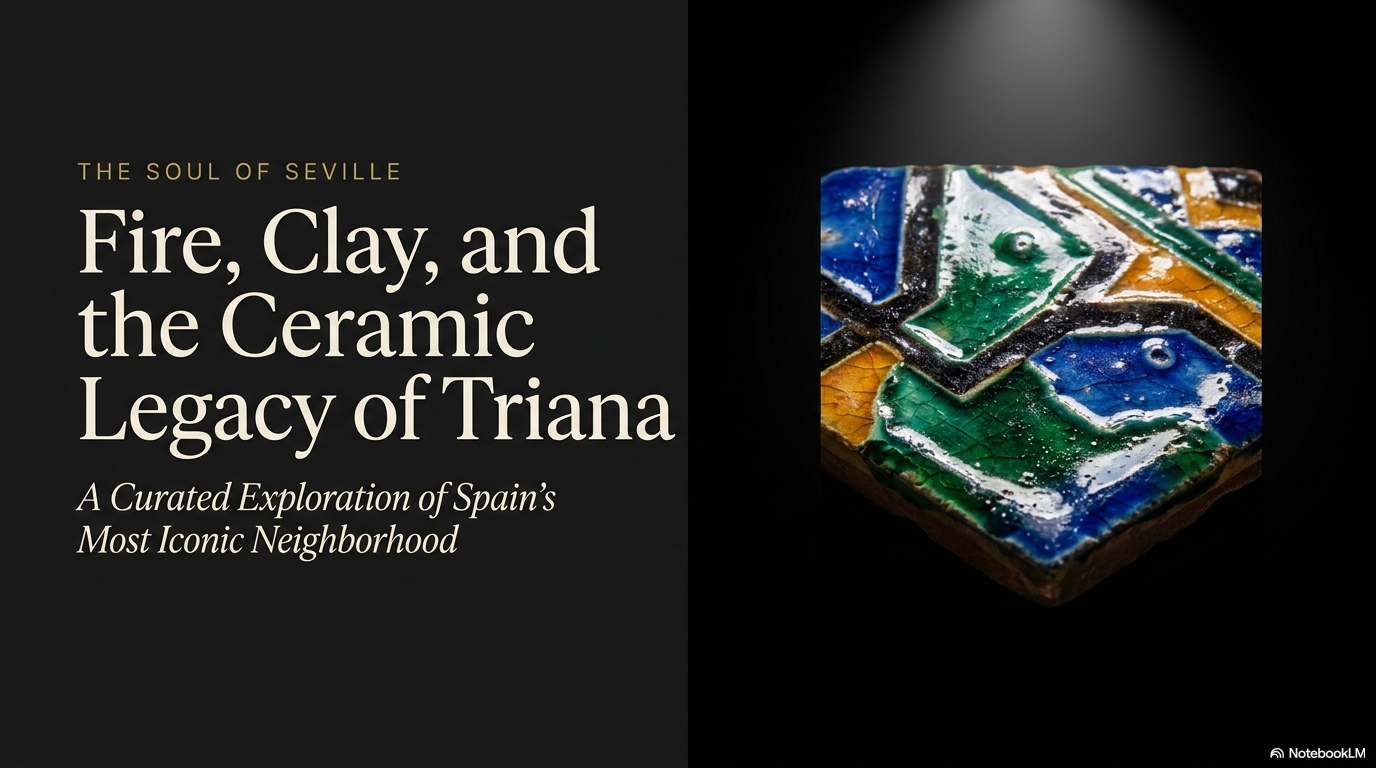
To speak of flamenco is to speak of Triana, that neighborhood that breathes history from every corner, where the Guadalquivir became border, refuge, and stage. Triana was not just a physical place: it was a human laboratory, a crossroads where gypsies, sailors, artisans, potters, freed slaves, moriscos, converted Jews, and humble people lived side by side — with more heart than resources.
In the 18th and 19th centuries, Triana was harsh, poor, full of life and noise. The tenement houses, the corrales, the shared patios… were spaces where music was not entertainment: it was emotional survival. There the first cantes we today recognize as flamenco were born: the martinete, struck on the blacksmith's anvil; the toná, a naked song without guitar, pure lament; the seguiriya, a torn scream that seems to come from a place older than memory.
Triana was the place where pain became art, where joy became fiesta, where daily life was sung just to endure it. Flamenco was not born in a theatre: it was born in a patio, in a forge, in a tavern, in a kitchen where someone tapped the table marking the compás.
II. The mixture that made it possible: gypsies, Andalusians, Africans, moriscos, Jews
Flamenco is the child of many cultures. There is no single root, but a tree with many branches:
The Gypsies, who arrived on the Peninsula in the 15th century, brought their way of feeling music, their inner rhythm, their way of living emotion.
The Moriscos left melodic modes, vocal turns, and ornamentations still heard today in cantes like the caña or the polo.
The Jews contributed scales, modes, and a spirituality that seeped into the deepest cantes.
The Africans, present in Andalusia since the Atlantic trade, left rhythms, syncopations, and patterns we still recognize in palos like alegrías and tangos.
The Andalusians brought popular poetry, the romance, the copla, the guitar, and the musical structure.
Flamenco is proof that when cultures mix, something powerful is born.
III. The Trinity: cante, toque and baile
The three pillars of flamenco do not accompany one another. They provoke, they argue, and they breathe as one living organism. El Cante is the soul, seeking truth over beauty. El Toque is the heart, provoking the dialogue. El Baile is the body, translating rhythm into physical truth.
IV. El Cante: the voice that crosses time
The flamenco cante is a way of singing that does not seek to be beautiful: it seeks to be true. It is a voice that seems to come from an ancient place, as if the cantaor were channeling something that does not belong to him alone.
Cantes grandes — soleá, seguiriya, toná, martinete — deep and solemn. Cantes festivos — bulerías, tangos, alegrías — joyful and rhythmic. Cantes de ida y vuelta — guajiras, milongas, colombianas — carrying the Latin American influence. Cantes mineros — tarantos, tarantas, cartageneras — songs of the mines. Cantes camperos — sevillanas, fandangos, verdiales — songs of the country.
Each palo has its own character, its history, its emotion. The cantaor does not interpret: he lives the cante.
V. El Toque: the guitar that dialogues
The flamenco guitar was not always there. The first cantes were a palo seco, without accompaniment. But when the guitar entered, everything changed.
The flamenco guitar became a second cantaor, an accomplice. It does not accompany: it dialogues. It does not follow: it provokes. It does not fill space: it breathes with the singer.
Triana and Jerez were key to its development, but Sevilla, Cádiz and Málaga also brought their own styles and schools. Rasgueos, alzapúas, picados, arpegios, golpes… a technique that demands both soul and precision.
VI. El Baile: body, earth and fire
Flamenco dance is a conversation between the body and the earth. It is not only technique: it is physical truth.
The gaze and hands tell stories without a single word. The torso, upright and proud, carries the weight of history with sober elegance. The heels and feet are an unbroken conversation with the soil, creating the percussive compás that drives the music forward.
Each gesture, each glance, each strike of the heel is a chapter.
VII. The spectrum of palos: mapping emotion
Every palo lives on a map between tragedy and light, between contained majesty and driving improvisation. Soleá, majestic and profound. Seguiriya, tragedy and desgarro. Farruca, masculine elegance and extreme sobriety. Tientos, mystery and containment. Taranto, mining hardness. And on the other side: bulerías of party and descaro; alegrías of Cádiz light and sea; tangos of sensual, steady rhythm; guajira with its Cuban coquetry.
VIII. From patios to global stages
As flamenco physically moved from hidden courtyards to global stages, it transformed into a spectacle — without ever losing its root. Patios and fraguas in the 18th century, intimate and private. Cafés cantantes in the 19th century, the first formal stages, where people paid to listen and feel. Tablaos, peñas and teatros in the 20th century, preserving the live essence alongside theatrical experimentation. And in the 21st century, global stages — a universal language radiating outward.
The cafés cantantes gave birth to legendary figures: Silverio Franconetti, La Serneta, El Nitri, La Niña de los Peines, Manuel Torre, Antonio Chacón. The tablao keeps the essence of the live encounter. The peña preserves the tradition. Theatres and festivals celebrate the diversity of the art.
IX. The global ecosystem: innovation without losing the soul
Today, flamenco is hybrid, brave and free. Yet, regardless of the musical fusion, the soul remains anchored in three absolutes: truth, emotion, and compás.
The roots — Triana, Jerez, Cádiz, Granada — still feed the tree. But the branches now reach Japan, the United States, France, and Mexico. Flamenco dialogues with jazz, electronic music, classical and pop. The alma remains the same.
Flamenco is not merely a musical genre. It is a survival mechanism that evolved into a way of being in the world — from fractured pain in the patios of Triana, through the alchemy of five cultures fusing into the Trinity of Cante, Toque and Baile, to a universal language recognized as Intangible Cultural Heritage of Humanity.
X. Triana: the place where it all stays alive
Triana is not a flamenco museum: it is a neighborhood where flamenco keeps happening. In a tavern, in a patio, in a family gathering, in an improvised fiesta. Triana does not teach flamenco: it breathes it.
Flamenco was born here because Triana is a neighborhood that lives with its heart in front. And as long as Triana exists, flamenco will exist.
Flamenco is a story of survival, mixture, pain, joy, resistance and beauty. An art born from humble people, today a Heritage of Humanity. A music that is not learned: it is inherited, felt, lived. Flamenco is Triana. Flamenco is Andalusia. Flamenco is the soul set to compás.