History & heritage · 12/11/2026 · 8 min read
The Royal Alcázar of Seville: A Palace of Kings, Poetry & Water
A thousand years behind one doorway
Outside, Seville is all footsteps, conversations and the occasional horse carriage. Inside the Alcázar, the rhythm changes. Water takes over from traffic. A courtyard draws your eyes upward. And suddenly the city is telling its story in a different voice.
I like to think of this place not as one palace, but as a conversation between centuries. Its origins reach back to the tenth century, and it remains a royal residence used by Spain's royal family during visits to Seville. That continuity is remarkable; the building you see today, however, was not all standing eleven hundred years ago.
Islamic rulers expanded the complex; Christian monarchs altered it, rebuilt parts of it and commissioned new rooms. Later generations brought Renaissance galleries, new gardens and further changes. Sometimes they preserved what came before. Sometimes they swept it away. Both decisions are part of the story.
Kings, poets and the danger of tidy labels
In the eleventh century, Seville's taifa ruler al-Mutamid made his court a centre of poetry and political life. His presence gives the Alcázar a literary soul as well as a royal one: here was a ruler remembered not only for territory, but for words.
Yet the palace refuses to fit neatly into three boxes. The surviving Patio del Yeso belongs to the later Almohad period, not to al-Mutamid's own reign. And the Gothic Palace began under Alfonso X after the conquest of Seville in 1248, rather than under the Catholic Monarchs. Those distinctions matter: they let us appreciate each layer without giving the wrong king the credit.
The Patio del Yeso: quiet power
The Patio del Yeso is one of the clearest surviving glimpses of the twelfth-century Almohad Alcázar. Arches, a delicate lattice of plasterwork and the still surface of a pool create a room that feels open to the sky but carefully protected from the world.
Look at the patterns rather than rushing through them. Repetition gives the eye somewhere to wander; water brings the architecture back down to earth in reflection. This is not simply decoration. It is a way of shaping light, shade and the experience of being inside a palace.
It evokes the wider world of al-Andalus, but it would be misleading to call it the very courtyard al-Mutamid knew: the surviving work came after him.
Pedro I: a palace with something to say
Then comes the palace commissioned by Pedro I in the fourteenth century, and the scale of the ambition becomes unmistakable. This Christian king chose the architectural language we call Mudéjar: Islamic artistic traditions developed under Christian rule.
Craftsmen connected with Seville, Toledo and Granada contributed to a world of carved plaster, tilework, inscriptions and timber ceilings. Castilian heraldry sits alongside Arabic lettering. The result is neither a simple copy of an Islamic palace nor proof that medieval society was free of conflict. It is a sophisticated expression of royal power, made through artistic exchange.
When I say that Pedro wanted a statement, I mean it as an interpretation, not a quotation from the king. The palace itself does most of the talking.
The Patio de las Doncellas: two centuries in one glance
The Patio de las Doncellas is the courtyard where many visitors stop mid-sentence. A long pool stretches between sunken planted beds, and the surrounding arches make even a small movement of light feel deliberate.
Archaeological work beginning in 2002 revealed the medieval garden beneath the later paving, allowing its arrangement to be recovered. Look upward and the chronology changes again: the upper gallery belongs to the Renaissance. The courtyard holds those different periods together without disguising the join.
Its name, the Courtyard of the Maidens, is often linked to the medieval legend of a tribute of one hundred maidens demanded by Muslim rulers. That is a legend, not a reliable account of what happened here. The real garden needs no invented tragedy to make it memorable.
The Ambassadors' Hall: look up, then linger
In the Salón de Embajadores, the ceiling seems to draw the whole room toward a single centre. Its gilded wooden dome turns a royal reception hall into something almost celestial.
The celebrated dome dates to 1427, after Pedro I's reign. It is another reminder that even the palace's most apparently unified rooms carry later additions. Geometry, carved timber and gilding combine to place royal authority beneath an image that invites comparison with the heavens.
The illustration explores how such a dome might be assembled, but it is a conceptual diagram, not a verified construction drawing. I would not turn its claim about a nail-free structure into a historical fact. Sometimes looking carefully is more rewarding than repeating a spectacular detail.
The Gothic Palace: another language of power
After the Christian conquest, Alfonso X commissioned a Gothic palace in the thirteenth century. Ribbed vaults and a different sense of scale gave the royal complex another architectural voice.
But this wing is no frozen medieval moment either. Later alterations reshaped its rooms, and the Hall of the Tapestries evokes Charles V's expedition to Tunis in 1535 through a later tapestry series. Naval imagery here belongs to woven hangings, not simply to medieval battle frescoes.
The contrast with the Mudéjar rooms is striking. Neither needs to erase the other for us to understand how profoundly Seville changed.
Water: beauty with a practical job
Water is the thread that keeps appearing: in pools, fountains, garden channels and the cool spaces beneath the palace. It reflects the architecture, accompanies a walk and reminds us that a garden also needs careful engineering.
The Mercury Pond was associated with storing water for the gardens before acquiring its present ornamental character. The underground space known as the Baths of Doña María de Padilla is a cistern, despite its romantic name.
The diagram gathers these places into a single flowing story. Read it as an illustration of water's importance, not as proof that every reservoir and garden was connected in exactly that sequence throughout the palace's history.
María de Padilla: where history meets romance
Beneath the palace, a long vaulted space and its reflections produce one of the Alcázar's most atmospheric sights. The name promises royal baths; the structure tells a more practical story of water storage.
María de Padilla was Pedro I's partner and the mother of several of his children. After her death, Pedro asserted that they had been married before his marriage to Blanche of Bourbon. Royal succession and legitimacy were entangled with that claim, so this is more than a simple tale of a king rewriting history for love.
The story of María bathing here belongs to the site's legends. We can enjoy the romance while keeping the cistern's real purpose in view.
The gardens: a different kind of royal room
Outside, the palace becomes paths, pavilions, hedges and fountains. The gardens developed over centuries, so an intimate older enclosure can give way to a broader, later landscape within a few steps.
The Mercury Pond and the raised Grotesque Gallery make a particularly memorable pairing. Elsewhere, palms, citrus trees and wandering peacocks change the mood again. I prefer to notice what is in front of us rather than promise a bird sighting or repeat an unverified story about its ancestry.
For some visitors, recognition comes through television: these gardens appeared as the Water Gardens of Dorne in Game of Thrones. The camera borrowed their atmosphere; it did not invent it.
Seville, the Atlantic and the screen
The Alcázar's story also reaches far beyond its walls. In 1503, the Casa de la Contratación was established in Seville, with premises within the royal complex, to administer aspects of Spain's developing Atlantic trade and navigation. That connection is firmer ground than the frequently repeated, poorly contextualised claim that Columbus met Isabella here immediately after his return.
Cinema offers another route into the palace: alongside Game of Thrones, the Alcázar has served as a location for productions including Lawrence of Arabia and Kingdom of Heaven. Its rooms can stand in for distant worlds because they already contain so many layers of their own.
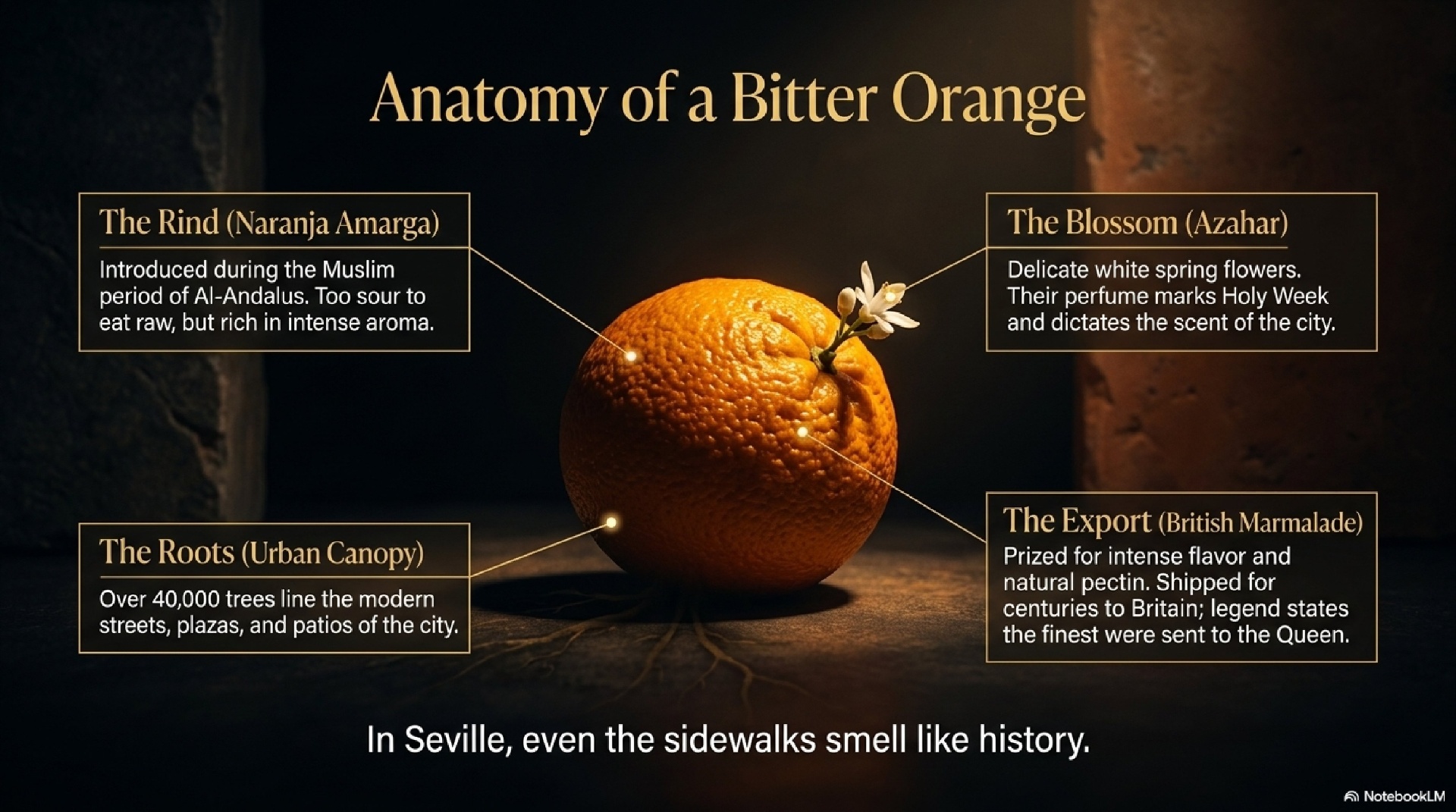
Seville's bitter oranges also have a well-known connection with marmalade. But a claim that this particular garden's fruit supplies a particular jar needs evidence. The same caution applies to secret tunnels: a good palace story is not automatically a documented one.
A living diary of Seville
What stays with me is not a list of monarchs. It is the way the Alcázar changes the pace of a conversation: a voice softens in a courtyard, someone stops beneath a ceiling, and a patch of reflected light holds our attention longer than expected.
This is a living diary of Seville, but not a diary without torn pages. Beauty, conflict, rebuilding and exchange all belong to it. Understanding those layers makes the palace more moving, not less.
The thirteen accompanying images are storytelling illustrations, not documentary photographs, measured plans or archaeological reconstructions. Where they simplify a date or repeat a legend, the text and captions make the distinction clear.
When we walk back into the city, the streets are the same. With luck, the way we look at them is not.